TWIN lift ball: closed-chain bimanual motion
This example adapts the TWIN/PerAct2 “lift ball” task to two Franka Panda arms. Each arm grasps a distinct handle on the same ball; the pair then raises it while both rigid grasp constraints remain active.
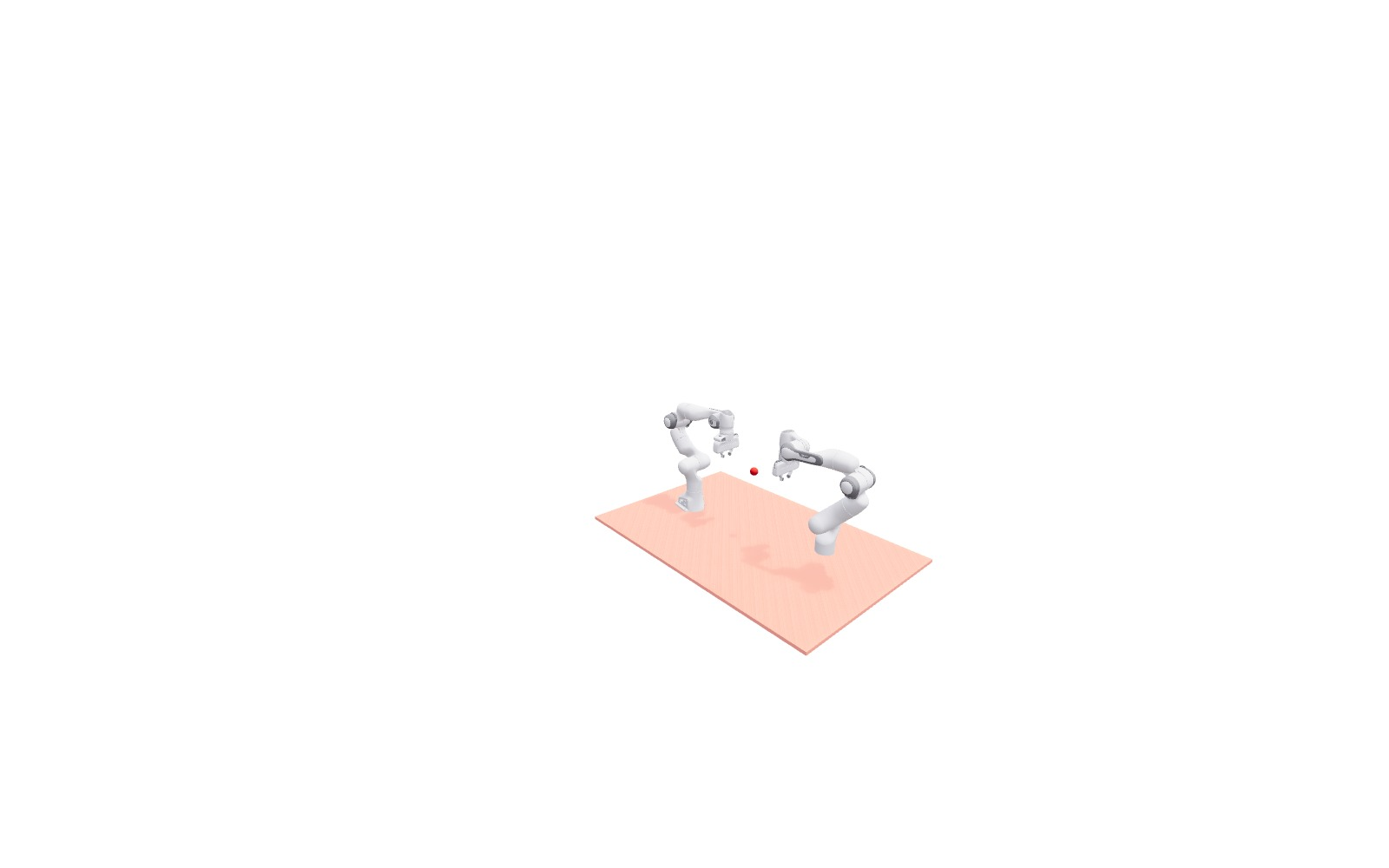
Fresh viser capture from the loaded 25-DOF scene, 27 September 2026.
Planning problem
The model has two independent seven-axis arms with articulated two-joint grippers and one free-flying ball. Finger joints remain fixed at a useful rendered width because grasp closure is represented by a rigid TCP constraint.
Why moving the ball directly fails
After both grasps activate, the ball pose is dependent on both arm configurations. Adding 10 cm to the ball’s free-flyer Z value creates an inconsistent guess; projection can return the ball to the same constrained pose with zero motion.
The implementation perturbs both arms’ panda_joint2, projects that guess onto the active dual-grasp node, and keeps the direction that raises the ball. It repeats in small steps because a single large projection may not converge and because the useful joint sign depends on the sampled elbow configuration.
for sign in (1, -1):
    q_guess[left_joint] += sign * step
    q_guess[right_joint] += sign * step
    ok, q_projected = config_gen.project_on_node(node, q_guess)
    if ok and ball_z(q_projected) > ball_z(q_current):
        keep(q_projected)
The resulting configuration already satisfies both grasps. plan_loop then searches for a collision-free path inside that constrained state.
Execution
python script/twin/task_lift_ball.py --backend pyhpp
python script/twin/task_lift_ball.py --backend pyhpp --viewer
Planning completes before the viser server starts. This ordering avoids a reproduced native concurrency failure when WebSocket visualization and the RRT/collision checker ran simultaneously.
Latest observed run
The 27 September 2026 run loaded the scene successfully and planned the left-arm grasp. Its first phase took 80.92 s. The second-arm pregrasp target projected, but all path attempts failed because panda_left/panda_leftfinger_2 collided with ball/base_link_0. The process exited before dual grasp and lift.
This result narrows the current issue to collision semantics around the already-held left grasp. It also means the former wording that the example demonstrated a completed cooperative lift was too strong. The implementation supports that intended flow, while the current checked configuration did not complete it.
Limitations and next measurement
The implementation reports the two grasp phases independently from the final constrained lift, so a failed lift does not erase earlier phase evidence. The source contains no pinned multi-seed result set or completed replay media. Accordingly, this example currently demonstrates scene loading, phase-graph construction, and one-arm grasp planning; it is not yet a successful bimanual benchmark.
A complete evaluation should record grasp success, achieved vertical displacement, closed-chain planning time, path length, minimum collision clearance, and failure classification across fixed seeds.